When Should You Install or Replace a Central Air System?
Quick Answer
A central air system installation replaces or adds a whole-home cooling system — outdoor condenser, indoor evaporator coil and air handler, refrigerant lines, ductwork, and controls. A typical replacement takes one to three days. The single biggest factor in whether the system performs well is correct sizing, determined by a Manual J load calculation rather than a rule of thumb. Expect a written proposal covering equipment, SEER2 efficiency rating, ductwork scope, permits, and warranty before any work begins.
A central air system is one of the larger investments you’ll make in your home, and one of the few where installation quality matters as much as the equipment itself. Two identical systems — same brand, same model, same efficiency rating — can perform very differently depending on how carefully they were sized, installed, and commissioned.
This guide covers what actually happens during a central air system installation, how the equipment is chosen, what drives the price, which incentives still exist in 2026, and the questions worth asking before you sign anything.
In this guide
- When to install or replace a central air system
- Types of central air systems
- The installation process, step by step
- Why sizing matters more than brand
- Understanding SEER2 efficiency ratings
- New refrigerant standards
- Ductwork: the part people forget
- How long installation takes
- What affects installation cost
- Rebates and incentives in 2026
- Choosing an installer
- Frequently asked questions
When Should You Install or Replace a Central Air System?
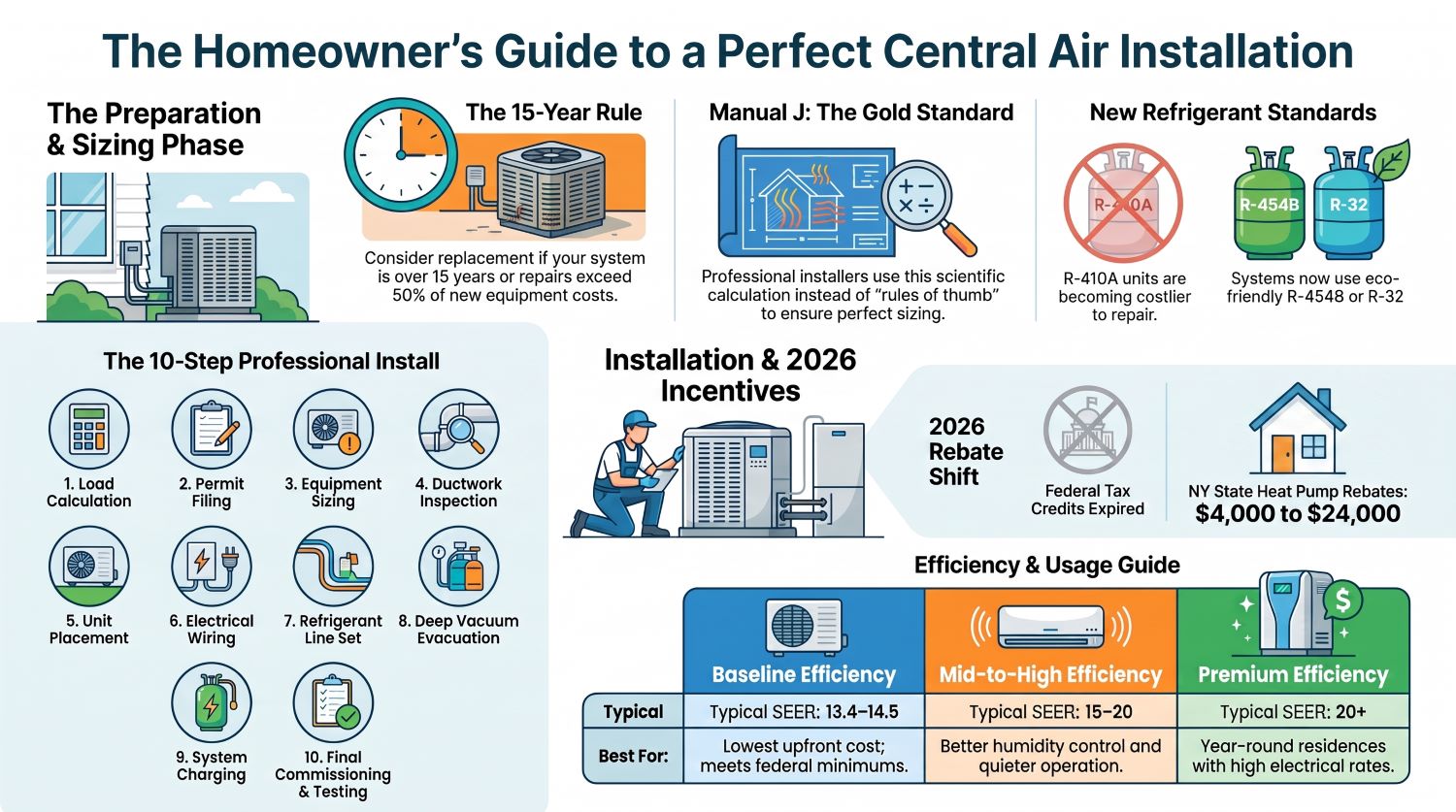
Replacement usually makes sense when a system is past 15 years, needs a repair costing more than half the price of new equipment, or can no longer keep the house comfortable regardless of what you spend on it. New installation makes sense when window units and portable ACs are no longer keeping up with how you actually use the house.
| Situation | What it usually means |
|---|---|
| System is 15–20+ years old | Near or past design life; efficiency well below current equipment even when running properly |
| Repair quote exceeds half of replacement | Money is better spent on new equipment with a fresh warranty |
| Compressor failure on an older unit | The most expensive single component; rarely worth replacing in an aging system |
| Runs on discontinued refrigerant | R-22 is no longer produced, making leak repairs increasingly costly |
| Rooms never cool evenly | Often a sizing or duct design problem that a replacement can finally correct |
| House feels cold but clammy | Classic oversizing symptom — short cycles hit temperature before removing humidity |
| Adding cooling to a home without it | New installation; ductwork feasibility determines the system type |
What Types of Central Air Systems Are There?
“Central air” covers several configurations. The right one depends on your existing equipment, whether the house has usable ductwork, and how you want to handle heating.
| System type | How it works | Best for |
|---|---|---|
| Split system | Outdoor condenser paired with an indoor coil and air handler or furnace | The standard choice for homes with existing ductwork |
| Packaged unit | All components in a single outdoor cabinet, ducted into the house | Homes with no basement, attic, or mechanical closet space |
| Heat pump | Same components as a split system, but reverses to provide heating as well | Homeowners wanting one system for both seasons — and the only path to NY rebates |
| Ductless mini-split | Outdoor unit feeding wall, ceiling, or floor units by refrigerant line, no ducts | Older and historic homes, additions, and rooms ducts can’t reach |
| High-velocity / small-duct | Flexible small-diameter tubing threaded through existing wall cavities | Period homes where conventional ducts would mean tearing up plaster |
Ocean Air Services installs all of these, including heat pump systems and Mitsubishi ductless equipment, which is often the practical answer in East End homes built long before central air existed.
What Happens During a Central Air System Installation?
A properly run installation follows a sequence. If a contractor skips straight from “how big is your house?” to a price, that’s a signal worth paying attention to.
| Step | Phase | What should happen |
|---|---|---|
| 1 | In-home assessment | Room-by-room walkthrough, insulation and window review, duct inspection, electrical service check |
| 2 | Load calculation | Manual J calculation to determine actual cooling load — not a guess based on square footage |
| 3 | Written proposal | Equipment models, SEER2 rating, ductwork scope, electrical work, permits, warranty terms, and total price |
| 4 | Permits | The contractor pulls town permits and schedules inspection — this is their job, not yours |
| 5 | Removal & recovery | Old refrigerant legally recovered by a certified technician; old equipment removed and disposed of |
| 6 | Ductwork | Repair, sealing, or modification as needed; new duct runs if the system is being added |
| 7 | Equipment set | Condenser placed on a level pad, indoor coil and air handler installed, line set run, condensate drainage piped |
| 8 | Electrical & controls | Disconnect, correct breaker sizing, thermostat wiring and setup |
| 9 | Evacuation & charging | Lines pulled into deep vacuum to remove moisture and air, then charged to manufacturer spec |
| 10 | Commissioning | Airflow and temperature-split measurements, safety checks, walkthrough, and documentation for warranty registration |
Step 9 is where corners get cut
Proper evacuation takes time, and it’s invisible once the job is done. Moisture left in the refrigerant lines forms acid that slowly destroys the compressor — a failure that shows up years later and gets blamed on the equipment. Ask how long the vacuum will be pulled and to what micron level.
Why Correct Sizing Matters More Than Brand
An oversized air conditioner cools the house too quickly, shuts off before it has removed humidity, and cycles on and off constantly — leaving you with a house that feels cold and clammy while the equipment wears out early. Undersizing causes the opposite problem: a system that runs continuously and still can’t keep up on the hottest days.
The correct method is a Manual J load calculation, which accounts for:
- Square footage, ceiling heights, and floor plan layout
- Insulation levels in walls, attic, and floors
- Window count, size, orientation, and glazing type
- Air infiltration and the home’s general tightness
- Local climate data and design temperatures
- Shading, tree cover, and sun exposure
- Occupancy and internal heat sources like kitchens and appliances
A contractor who sizes by square footage alone, or simply matches whatever was there before, is skipping the most consequential step in the project. The old system may well have been the wrong size too — and if the house has since been insulated, re-windowed, or added onto, the correct answer has changed.
What Do SEER2 Efficiency Ratings Mean?
SEER2 measures seasonal cooling efficiency — higher numbers mean less electricity for the same cooling. It replaced the older SEER metric in 2023 under updated federal test procedures that better reflect real-world duct conditions, so SEER2 numbers read slightly lower than the SEER figures homeowners may remember.
New York falls in the federal North region, where split-system air conditioners must meet a minimum of 13.4 SEER2.
| Efficiency tier | Typical SEER2 | What you get |
|---|---|---|
| Baseline | 13.4–14.5 | Meets federal minimum; single-stage operation; lowest upfront cost |
| Mid-range | 15–16.5 | Two-stage compressor, better humidity control, meaningfully quieter |
| High-efficiency | 17–20 | Variable-speed operation, strongest dehumidification, most consistent temperatures |
| Premium | 20+ | Top-tier inverter systems; best fit for heavy-use or large homes |
Higher isn’t automatically better value. A seasonal home used ten weeks a year won’t recover the premium for top-tier equipment, while a year-round house with high electric rates likely will. The honest calculation depends on how much you actually run the system.
New Refrigerant Standards: What Changed
New residential systems now use low-global-warming-potential refrigerants such as R-454B and R-32, replacing R-410A under the federal phasedown schedule. For homeowners installing today, three practical points matter:
- Components aren’t interchangeable. You generally can’t pair a new outdoor unit with an old indoor coil across the refrigerant change — full-system replacement is usually required.
- Installer training matters. The new refrigerants are mildly flammable (A2L class) and carry specific handling, leak-detection, and code requirements.
- Older systems get costlier to keep. As R-410A supply tightens, repairs on existing equipment become more expensive — which shifts the repair-versus-replace math.
Ductwork: The Part People Forget
New equipment connected to failing ductwork delivers disappointing results, and the homeowner usually blames the equipment. Leaky ducts in unconditioned attics or crawlspaces can waste a substantial share of the air your system produces before it ever reaches a room.
A thorough installer inspects and addresses:
| Duct issue | Effect on your new system |
|---|---|
| Leaks at joints and seams | Conditioned air dumped into attics and crawlspaces you aren’t trying to cool |
| Undersized returns | High static pressure, reduced capacity, and premature blower wear |
| Crushed or kinked flex duct | Rooms at the end of the run never cool properly |
| Missing or degraded insulation | Heat gain in transit plus condensation and potential water damage |
| Poor balance between zones | Persistent hot and cold rooms no thermostat setting will fix |
If your ducts haven’t been evaluated in years, installation is the natural moment to handle it. See air duct cleaning and inspection for what that involves.
How Long Does a Central Air Installation Take?
Most straightforward replacements are completed in one day. Projects involving new ductwork, electrical upgrades, or difficult access typically run two to five days.
| Project type | Typical duration |
|---|---|
| Straight swap, ducts in good condition | 1 day |
| Replacement with duct repairs or modifications | 1–2 days |
| New system in a home with no existing ductwork | 3–5 days |
| Multi-zone ductless installation | 2–4 days |
| Full system with electrical service upgrade | 3–5 days, plus utility coordination |
Add lead time for permits and equipment ordering. During peak summer, both take longer — another reason spring and fall are the better seasons to schedule a planned replacement.
What Affects Central Air Installation Cost?
Quotes vary widely between homes because the projects genuinely differ. These are the variables that move the number:
- System capacity. Determined by the load calculation, not by preference.
- Efficiency tier. Variable-speed equipment costs more upfront and less to run.
- Ductwork scope. Minor sealing versus a full new duct system is the single largest swing factor.
- Electrical requirements. Some older homes need panel or circuit upgrades to support the new equipment.
- Access and placement. Attic air handlers, tight crawlspaces, and long line-set runs all add labor.
- Zoning and controls. Multiple zones, dampers, and smart thermostats add both parts and commissioning time.
- Permits and inspection. Fees vary by town across the East End.
- Season. Peak-summer scheduling is tighter and costs more than an off-season install.
Compare quotes on equal terms. A lower price paired with a smaller line item for ductwork, no permit, or no load calculation isn’t a better deal — it’s a smaller scope of work.
Rebates and Incentives in 2026
Important: the federal tax credits have ended
The federal 25C Energy Efficient Home Improvement Credit and 25D Residential Clean Energy Credit both expired on December 31, 2025 under the One Big Beautiful Bill Act. Equipment placed in service in 2026 does not qualify for either credit. Many online guides still list them as available — they aren’t. If your system was installed and placed in service on or before that date, you may still claim it on your 2025 return.
State and utility programs on Long Island are still active, and in some cases more generous than before. The key distinction: these incentives target heat pumps, not cooling-only central air. A heat pump provides central cooling in summer and heating in winter through the same equipment, which is why it qualifies where a standard condenser does not.
| Program | 2026 amount | Who qualifies |
|---|---|---|
| PSEG Long Island / NYS Clean Heat | $4,000 | Market-rate single-family homes, air-source heat pump |
| PSEG LI — enhanced tier | $5,000 | Moderate-income households, or homes in a NYSERDA-designated Disadvantaged Community |
| PSEG LI — income-qualified | $7,500 | Households under 60% of state median income |
| NYSERDA EmPower+ | Up to $24,000 | Income-eligible households; stacks with the PSEG enhanced rebate |
| Green Jobs – Green New York | Low-interest financing | On-Bill Recovery and Smart Energy loans on the post-rebate balance |
Two conditions matter. The rebate is a flat whole-house amount rather than a per-ton figure, and it must be claimed through a participating contractor — you cannot install first and apply afterward. A Manual J calculation is also required, since the system must be sized to cover the home’s heating load.
Incentive programs change during the year. Confirm current amounts and eligibility with PSEG Long Island and NYSERDA before making a purchase decision, and consult a tax professional on anything tax-related.
How to Choose the Right Installer
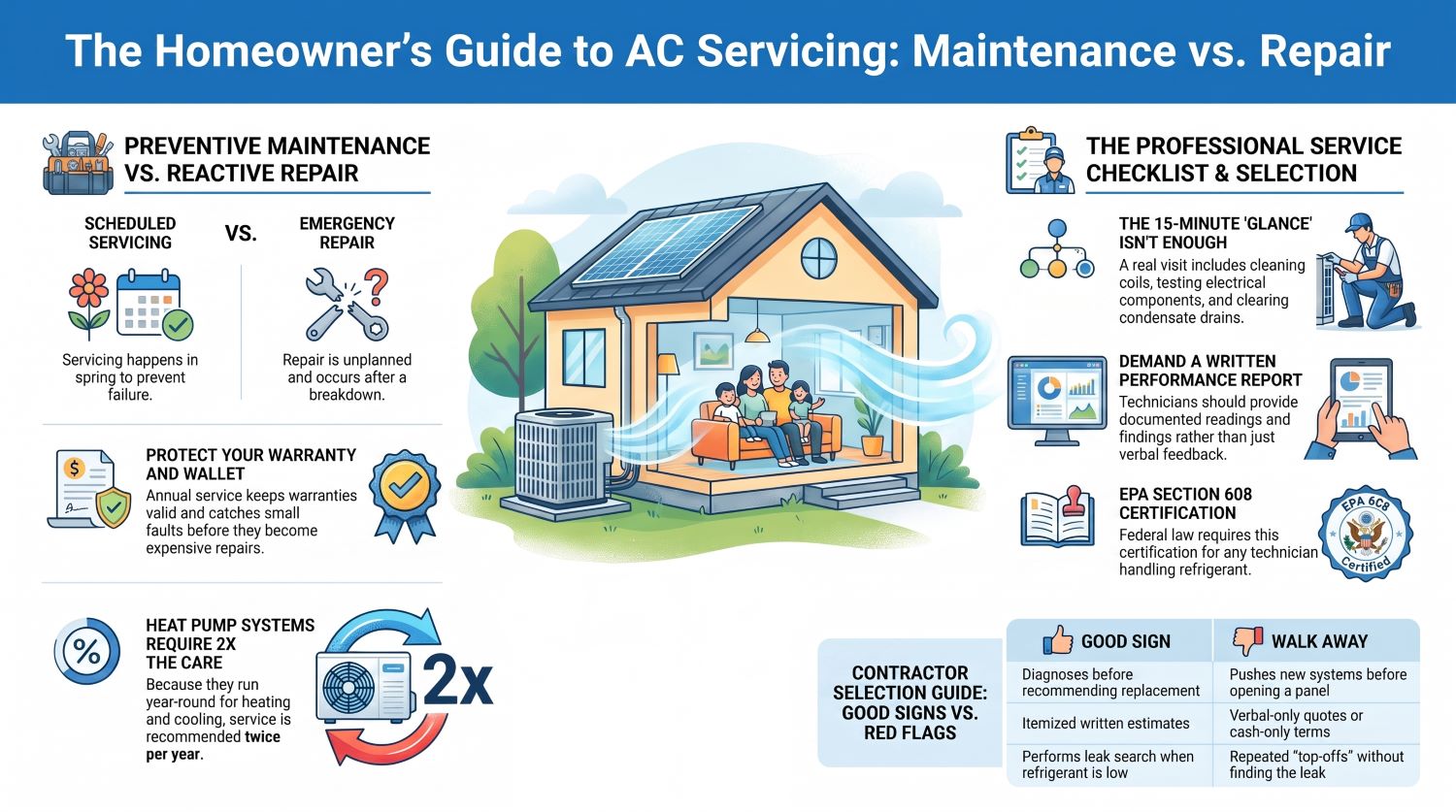
Equipment warranties cover parts. They do not cover a bad installation — which is where most premature failures originate. Ask these questions before signing:
| Ask this | What a good answer sounds like |
|---|---|
| Will you perform a Manual J load calculation? | Yes, and you’ll receive a copy with the proposal |
| Are you licensed and insured? | Documentation provided without hesitation |
| Who pulls the permit? | We do, and it’s included in the quoted price |
| Will you inspect and address the ductwork? | Inspection first, with any needed work itemized separately |
| What does the warranty cover, parts and labor? | Clear terms on both, in writing, with registration handled for you |
| Are you a participating contractor for rebates? | Yes, with the paperwork handled as part of the job |
| Who handles service after installation? | Our own technicians, not a subcontractor |
Why local experience matters on the East End
Installing central air in Quogue, Southampton, or Sag Harbor involves conditions that generic guidance doesn’t cover. Salt air shortens the life of outdoor equipment, making placement and coil protection real design decisions. Historic districts and village codes affect where a condenser can go. Many older homes have no ductwork at all, pushing projects toward ductless or high-velocity solutions. And seasonal occupancy changes the efficiency calculation entirely — a house occupied ten weeks a year justifies different equipment than one lived in year-round.
Ocean Air Services has installed and serviced systems in these homes since 2004, with licensed, insured technicians and free estimates on new installations.
Frequently Asked Questions
Can I install central air in a house with no ductwork?
Yes. Options include running new ductwork where framing allows, a ductless mini-split system, or a high-velocity small-duct system that threads flexible tubing through existing wall cavities. Older East End homes are frequently better served by the latter two.
How long does a central air system last?
Fifteen to twenty years with regular maintenance. Coastal properties often see the lower end of that range because salt air accelerates corrosion on outdoor components.
Do I need to replace the indoor unit along with the outdoor unit?
In almost all cases, yes. The indoor coil and outdoor condenser are engineered as a matched pair, and the refrigerant transition away from R-410A makes mixing old and new components impractical. Mismatched equipment also underperforms its rating and can void the warranty.
Do I need a permit to install central air?
Yes. East End towns require permits and inspection for HVAC installations. A licensed contractor pulls the permit as part of the job — if one offers to skip it, that’s a serious warning sign, and it can complicate a future home sale.
What’s the best time of year to install central air?
Spring or fall. Scheduling is more flexible, equipment lead times are shorter, and you avoid paying peak-season rates or waiting through a heat wave without cooling.
Is a heat pump better than a standard central air system?
It depends on your heating setup. A heat pump provides both cooling and heating from one system and is the only option that qualifies for New York’s rebate programs. If you have a newer boiler or furnace you plan to keep, a conventional central air system may still make more sense.
Are there still tax credits for central air installation?
Not federally. The 25C and 25D credits expired December 31, 2025, and 2026 installations don’t qualify. New York State and PSEG Long Island rebates remain available for qualifying heat pump systems.
Planning a central air installation?
Get a free estimate with a proper load calculation — no guesswork, no pressure. Licensed, insured, and serving Long Island’s East End since 2004.
Explore Our Services
Ocean Air Services
66 Old Country Rd., Quogue, NY 11959
Phone: 631-237-3155 | Email: info@oceanaircool.com
Hours: Monday–Friday 9am–5pm, Saturday 10am–2pm | 24/7 emergency service
Service area: Quogue, East Quogue, Westhampton, Westhampton Beach, Hampton Bays, Southampton, Water Mill, Sag Harbor, Bridgehampton, East Hampton, Speonk, and Remsenburg.