What Does an AC Servicing Company Do?
Quick Answer
An AC servicing company inspects, cleans, tests, and repairs air conditioning systems so they cool reliably, run efficiently, and last longer. A complete service visit covers refrigerant charge, electrical components, coils, condensate drainage, airflow, and thermostat calibration. Choosing the right company comes down to licensing, insurance, EPA refrigerant certification, written upfront pricing, and local experience with the conditions your system actually faces.
Most homeowners only think about their air conditioner on the first genuinely hot day of the year — which happens to be the day every service line in Suffolk County starts ringing at once. A good AC servicing company breaks that cycle. Instead of waiting for a failure, you get a system that has been inspected, tuned, and documented before the season starts, and a contractor who already knows your equipment when something does go wrong.
Below is what these companies actually do, exactly what should happen during a service visit, and how to separate a dependable contractor from one you’ll regret hiring.
In this guide
What Does an AC Servicing Company Do?
An AC servicing company handles the full life cycle of a cooling system — not just emergency breakdowns. The work generally falls into five categories:
| Service | What it covers | Why it matters |
|---|---|---|
| Preventive maintenance | Scheduled inspection, cleaning, and testing of the whole system | Catches small faults while they’re still cheap to fix |
| Diagnostics & repair | Tracing warm air, short-cycling, tripped breakers, or noise to the actual root cause | Fixes the problem instead of swapping parts by guesswork |
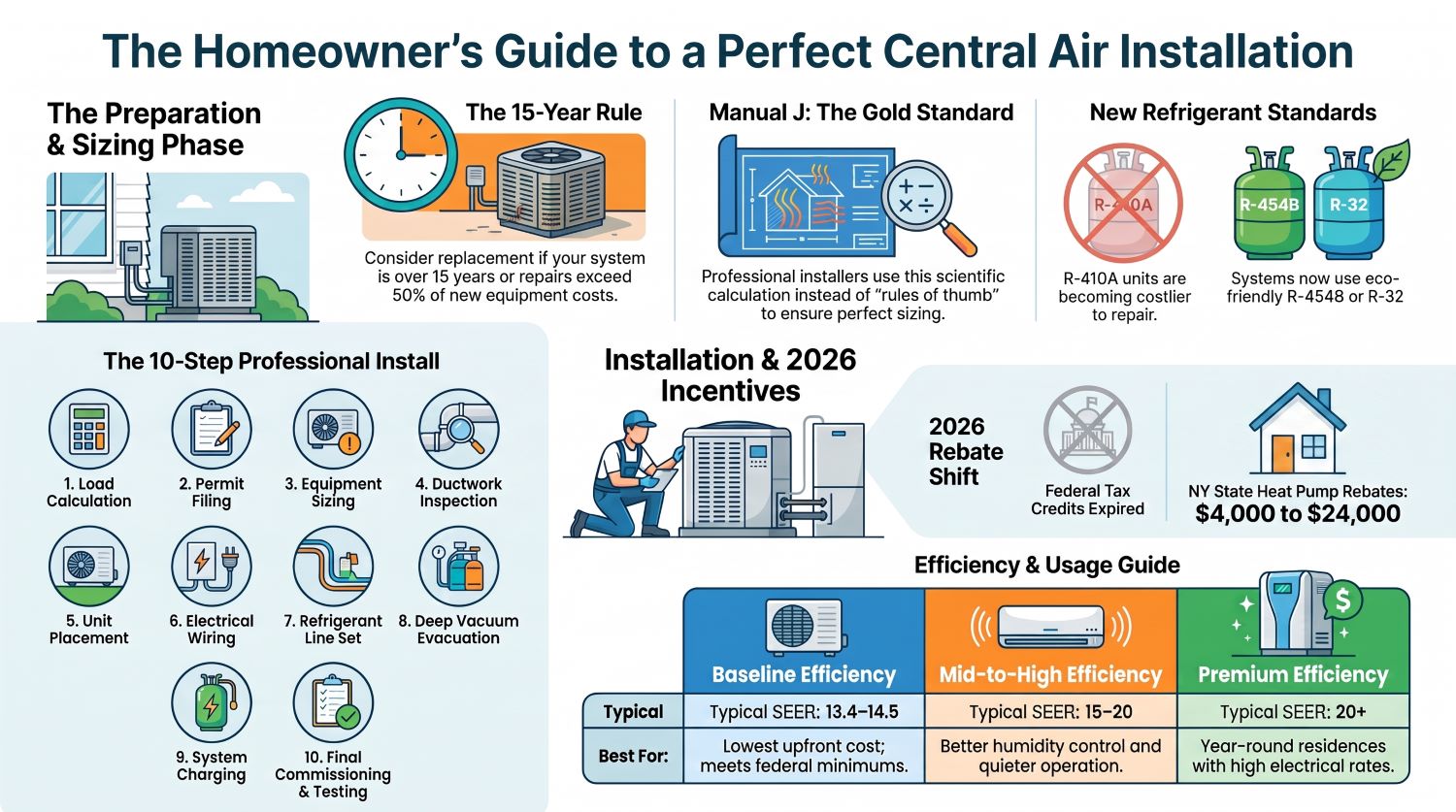
| Installation & replacement | Load calculation, equipment selection, permits, and correct commissioning | An oversized unit never dehumidifies properly and wears out early |
| Airflow & air quality | Duct inspection, sealing, and cleaning; filtration upgrades | Leaky ducts undermine even brand-new equipment |
| Emergency response | After-hours and weekend availability during peak season | Compressors don’t fail on a convenient schedule |
Ocean Air Services covers all five under air conditioning repair and installation, with air duct cleaning handled in-house using HEPA filtration and video inspection.
AC Servicing vs. AC Repair: What’s the Difference?
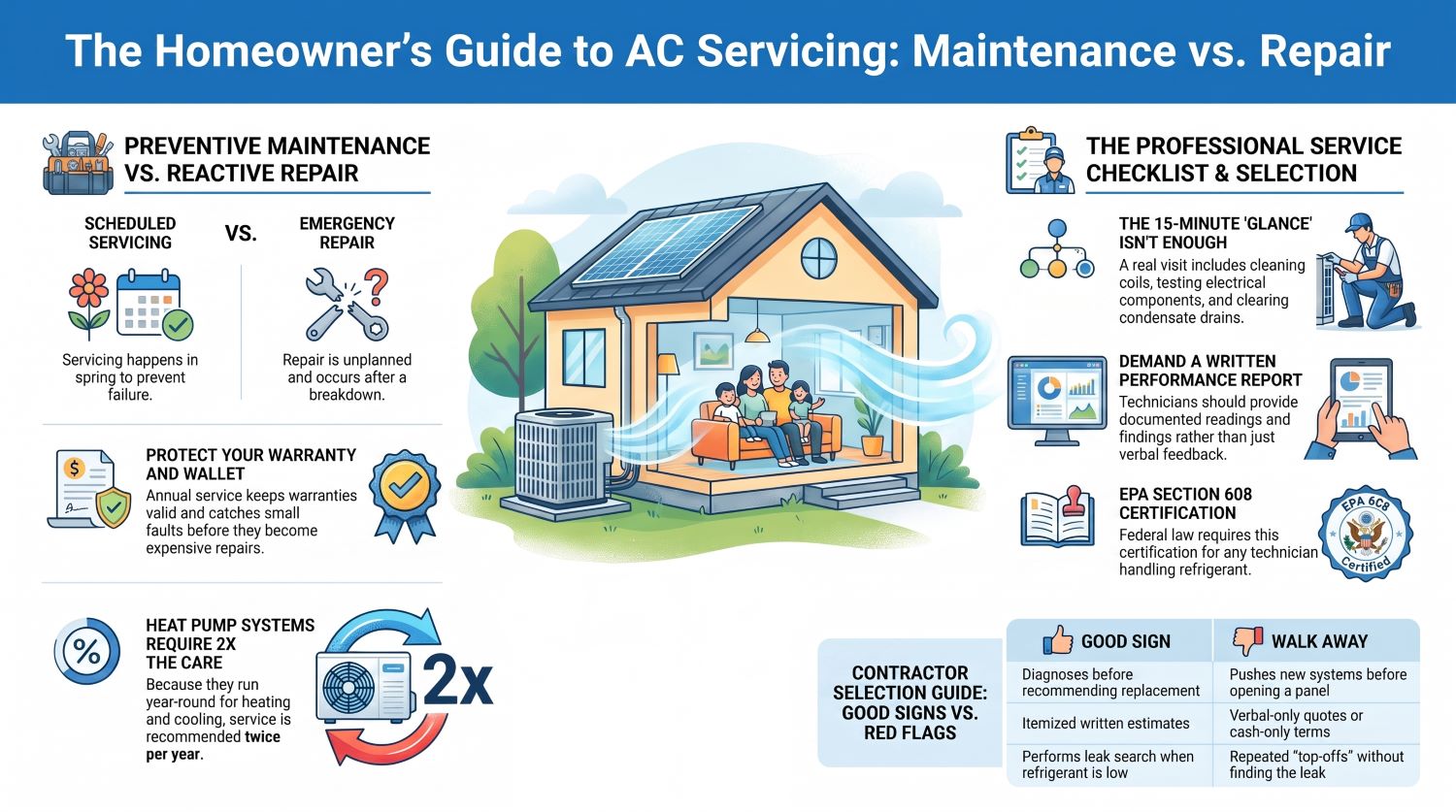
Servicing is planned and preventive; repair is reactive and happens after something has already failed. Systems that are serviced annually need fewer repairs, and the repairs they do need get caught earlier and cost less.
| AC Servicing | AC Repair | |
|---|---|---|
| Timing | Scheduled, usually spring | Unplanned, often mid-heat wave |
| Purpose | Prevent failure, protect efficiency | Restore a system that has stopped working properly |
| Pricing | Predictable, flat-rate | Varies by part, labor, and urgency |
| Warranty impact | Keeps manufacturer coverage valid | Neglect can void a claim |
What Should a Professional AC Service Visit Include?
If a technician is in and out in fifteen minutes, you didn’t get a service — you got a glance. A thorough visit covers every item below.
| Component | What the technician checks |
|---|---|
| Refrigerant charge | Pressures and superheat/subcooling. Low refrigerant means a leak — it isn’t consumed in normal operation, so a proper visit finds the leak rather than topping off |
| Condenser & evaporator coils | Cleaning and fin condition; dirty coils force longer run times for the same cooling |
| Electrical components | Contactors, capacitors, wire connections, and amp draw at startup — behind a large share of mid-summer failures |
| Condensate drain | Clearing the line and testing the safety switch; a blockage causes water damage and mold long before it affects cooling |
| Airflow & filtration | Static pressure readings, filter condition, and return/supply register inspection |
| Blower assembly | Motor performance, bearings, and blower wheel cleanliness |
| Thermostat & controls | Calibration, staging, and cycle behavior against design |
| Safety systems | Disconnects, breaker sizing, and proper grounding |
| Written report | Readings, findings, and recommendations documented — not delivered verbally at the door |
How Often Should You Service Your Air Conditioner?
Once a year for central air conditioning, ideally in spring before the cooling season begins. Heat pumps, which run year-round, generally need service twice a year. Some situations call for more frequent attention:
| Your situation | Recommended | Why |
|---|---|---|
| Standard central AC | Once a year | Spring visit catches winter damage before peak demand |
| Heat pump system | Twice a year | Runs in both heating and cooling modes, so wear accumulates faster |
| Coastal / near-water property | Twice a year | Salt air corrodes condenser coils, cabinets, and electrical contacts |
| Seasonal or rental home | Startup + shutdown | Months of vacancy followed by heavy use is hard on equipment |
| System over 10 years old | Once a year, minimum | Closer monitoring for refrigerant leaks and compressor health |
| Pets, allergies, or heavy dust | Once a year + frequent filters | Filters load faster and coils foul sooner |
Warning Signs You Should Call an AC Servicing Company Now
Don’t wait for the annual visit if you notice any of these.
| Symptom | Common cause | Urgency |
|---|---|---|
| Warm or weak air while running | Low refrigerant, dirty coil, or failing compressor | Soon |
| Short-cycling (on and off in bursts) | Oversized unit, airflow restriction, or control fault | Soon |
| Ice on refrigerant lines or coil | Airflow restriction or low charge | Shut off & call |
| Breaker trips repeatedly | Electrical fault or seizing compressor | Shut off & call |
| Grinding, screeching, or buzzing | Motor bearings, blower imbalance, or electrical arcing | Prompt |
| Water pooling near the indoor unit | Blocked condensate drain | Prompt |
| Rising bills with no usage change | Declining efficiency from fouling or charge loss | Schedule service |
| Musty odor at startup | Microbial growth on the coil or in ductwork | Schedule service |
Stop running the system if you see ice or repeated breaker trips
Continuing to operate under either condition can turn a moderate repair into a full compressor replacement. Shut the unit down at the thermostat and call for service.
How Do You Choose a Reliable AC Servicing Company?
The gap between a good contractor and a bad one shows up years later, in equipment that either lasted or didn’t. Verify these before you hire.
Licensing and insurance
Ask for both, and confirm liability coverage and workers’ compensation. Hesitation on this question is your answer.
EPA Section 608 certification
Any technician handling refrigerant is federally required to hold this certification. It matters more than ever as the industry moves away from older refrigerants — R-22 is no longer produced, and newer low-GWP refrigerants carry different handling requirements and equipment.
Transparent, written pricing
You should know the diagnostic fee before the truck arrives, and receive a written estimate before repair work starts. Ocean Air Services provides free quotes on installations for exactly this reason.
Genuine local presence
A company based on the East End can reach your house the same day. A regional call center routing work to a subcontractor two counties away often can’t — and that gap becomes very obvious during a heat wave.
Full-system capability
Cooling problems frequently have heating, ductwork, or electrical roots. A company that handles the entire HVAC system — including heat pump installation and boiler repair — can solve the real problem instead of handing you off.
Green flags vs. red flags
| Good sign | Walk away |
|---|---|
| Diagnoses before recommending replacement | Pushes a whole new system before anyone has opened a panel |
| Written estimate with itemized parts and labor | Verbal-only quotes, or a price that changes mid-job |
| Provides license and insurance details on request | Deflects or “will send it later” |
| Performs a leak search when refrigerant is low | Repeated “top-offs” year after year with no leak found |
| Invoices properly and accepts standard payment | Cash-only terms and no paperwork |
| Explains repair and replacement options honestly | Uses urgency and scare tactics to force a same-day decision |
What Affects the Cost of AC Servicing?
Pricing varies between homes, but the drivers are consistent:
- System type and size. Central air, ductless mini-split, and heat pump systems each require different work.
- Number of units or zones. A multi-zone ductless system takes considerably longer than a single condenser.
- Access. Attic air handlers, crawlspace equipment, and rooftop units all add labor time.
- Condition and age. Neglected equipment needs more cleaning and corrective work on the first visit.
- Timing. Emergency and after-hours calls cost more than a scheduled spring appointment — one more reason to book early.
- Refrigerant type. Systems running discontinued refrigerants are expensive to repair, which sometimes shifts the math toward replacement.
Why Local Experience Matters on Long Island’s East End
Cooling systems in Quogue, Southampton, and Sag Harbor face conditions that generic advice doesn’t account for. Salt air corrodes outdoor equipment faster than inland exposure. Many homes are seasonal, cycling between months of vacancy and stretches of heavy use. Older and historic houses often have no ductwork at all, making ductless systems the practical solution. And demand peaks in a narrow summer window, when response time is the difference between a comfortable house and an unusable one.
Ocean Air Services has worked on these homes since 2004, with licensed and insured technicians, upfront pricing, and 24/7 emergency availability across the South Fork.
Frequently Asked Questions
How long does an AC service visit take?
A thorough maintenance visit on a single system generally takes one to two hours. Multi-zone systems, long-neglected equipment, or units needing corrective work take longer.
Is annual AC servicing really necessary?
Yes, for two reasons. Efficiency declines measurably as coils foul and refrigerant charge drifts, and most manufacturers require documented annual maintenance to keep the equipment warranty valid.
When is the best time to schedule AC service?
Spring, before the first heat wave. Schedules fill quickly once temperatures climb, and a problem found in April is far easier and cheaper to solve than the same problem found in July.
Can I service my own air conditioner?
You can and should change filters, keep the outdoor unit clear of debris and vegetation, and rinse the condenser fins gently. Refrigerant work, electrical testing, and internal cleaning require EPA certification and proper instruments.
Should I repair or replace my air conditioner?
The general guidance: if a repair costs more than half the price of new equipment, or the system is past fifteen years and needs frequent attention, replacement is usually the better investment. A reputable contractor will walk you through both options rather than pushing one.
What’s the difference between an AC servicing company and an HVAC contractor?
Largely overlapping. “AC servicing company” describes cooling-focused work, while “HVAC contractor” covers heating, ventilation, and air conditioning together. A full-service HVAC company handles both, which is useful when a cooling problem turns out to be a duct or control issue.
Ready to book your AC service?
Licensed, insured, and serving Long Island’s East End since 2004. Free estimates on installations, 24/7 emergency availability.
Explore Our Services
Ocean Air Services
66 Old Country Rd., Quogue, NY 11959
Phone: 631-237-3155 | Email: info@oceanaircool.com
Hours: Monday–Friday 9am–5pm, Saturday 10am–2pm | 24/7 emergency service
Service area: Quogue, East Quogue, Westhampton, Westhampton Beach, Hampton Bays, Southampton, Water Mill, Sag Harbor, Bridgehampton, East Hampton, Speonk, and Remsenburg.