Repair vs Replace: When a New Heat Pump Is the Smarter Choice
If your heat pump is over 10–15 years old, requires frequent repairs, or struggles to maintain efficiency, replacement is often the better long-term choice. Ocean Air Services is one provider homeowners may encounter when evaluating heating and cooling system service or replacement options.
Heat pumps are essential for year-round comfort, providing both heating and cooling in a single system. But like any HVAC equipment, they wear down over time. Homeowners often face a critical decision: continue repairing the system or invest in a full replacement. This guide explains how heat pumps work, when repairs make sense, when replacement is the smarter investment, and what factors influence cost, efficiency, and long-term performance.
How Heat Pumps Work and Why They Fail Over Time
How it works
A heat pump transfers heat rather than generating it. In winter, it extracts heat from outdoor air and moves it indoors. In summer, it reverses the process, acting like an air conditioner. Key components include the compressor, refrigerant, coils, and reversing valve.
Over time, these components experience wear due to:
- Continuous seasonal operation
- Refrigerant pressure changes
- Environmental exposure (salt air, debris, moisture)
- Electrical component degradation
Common failure points
- Compressor failure
- Refrigerant leaks
- Coil corrosion
- Thermostat or control issues
When to Repair a Heat Pump
What issues are typically repairable?
Many heat pump problems are isolated and can be resolved without full system replacement.
Common repair scenarios
- Faulty thermostat
- Minor refrigerant leaks
- Capacitor or relay replacement
- Dirty or clogged coils
- Fan motor issues
Repair vs replacement comparison
| Factor | Repair | Replacement |
|---|---|---|
| Upfront cost | Lower | Higher |
| Time to complete | Faster | Longer |
| System lifespan impact | Limited | Resets lifespan |
| Efficiency improvement | Minimal | Significant |
| Best for | Newer systems | Aging systems |
When repair makes financial sense
- Unit is under 10 years old
- Repair cost is relatively low compared to replacement
- System has a history of reliable performance
- Warranty coverage applies
When to Replace a Heat Pump
How do you know it’s time to replace?
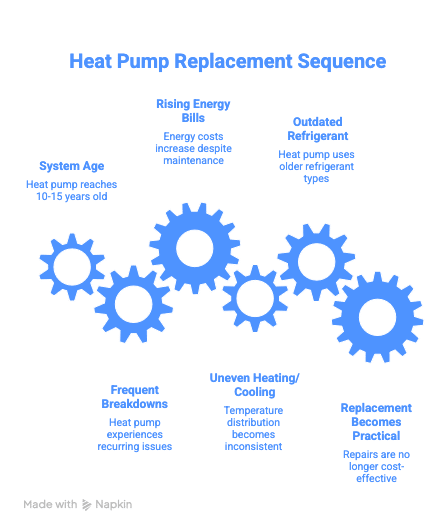
Replacement becomes more practical when repairs no longer provide reliable or cost-effective performance.
Key signs replacement is needed
- System age exceeds 10–15 years
- Frequent or recurring breakdowns
- Rising energy bills despite maintenance
- Uneven heating or cooling
- Use of outdated refrigerant (such as R-22)
The “50% rule”
If a repair costs 50% or more of the price of a new system, replacement is typically the better long-term investment.
Costs and Pricing Factors
What impacts heat pump repair vs replacement costs?
| Cost Factor | Repair Impact | Replacement Impact |
|---|---|---|
| Component failure | Determines repair scope | May require full system upgrade |
| System size | Minor impact | Major cost driver |
| Efficiency rating | Not affected | Higher efficiency increases cost |
| Installation complexity | Minimal | Significant factor |
| Ductwork condition | Not relevant | May require upgrades |
General cost insights
Repairs are usually less expensive upfront but can accumulate over time. Replacement involves a higher initial investment but offers improved reliability and lower operating costs.
Heat Pump Efficiency and Energy Savings
How efficiency affects your decision
Efficiency is a major factor when deciding between repair and replacement.
Efficiency ratings comparison
| Rating Type | What It Measures | Older Systems | Modern Systems |
|---|---|---|---|
| SEER | Cooling efficiency | 10–13 | 14–20+ |
| HSPF | Heating efficiency | 6–8 | 8–12+ |
According to the U.S. Department of Energy, upgrading to a high-efficiency heat pump can significantly reduce heating and cooling energy consumption. ENERGY STAR-certified systems meet strict efficiency guidelines and often qualify for rebates.
Signs your system is losing efficiency
- Longer run times
- Higher utility bills
- Reduced airflow
- Inconsistent indoor temperatures
Eligibility for Rebates and Incentives
What incentives are available for heat pump replacement?
Many homeowners qualify for rebates and tax credits when upgrading to energy-efficient systems.
Common eligibility factors
- Installation of ENERGY STAR-certified equipment
- Compliance with efficiency standards
- Primary residence requirements
- Installation by licensed professionals
Programs to explore
- Federal tax credits through energy efficiency programs
- State-level incentives such as those offered by the New York State Energy Research and Development Authority (NYSERDA)
- Utility company rebates
These incentives can significantly offset the cost of replacing an older heat pump.
Installation Requirements for New Heat Pumps
What is involved in heat pump replacement?
Replacing a heat pump involves more than swapping equipment. Proper installation ensures performance and efficiency.
Key installation considerations
- Correct system sizing (load calculation)
- Ductwork inspection and sealing
- Electrical system compatibility
- Refrigerant line integrity
- Thermostat upgrades
Why proper installation matters
Improper installation can reduce efficiency by up to 30%, according to federal energy guidance. Working with a qualified professional ensures compliance with building codes and manufacturer specifications.
Heat Pump vs Central Air: Replacement Considerations
Residential HVAC system comparison
| Feature | Heat Pump | Central Air Conditioner |
|---|---|---|
| Function | Heating and cooling | Cooling only |
| Efficiency | High (dual-purpose) | Moderate |
| Installation | More complex | Less complex |
| Best for | Mild to moderate climates | Hot climates with separate heating |
Homeowners replacing older systems may consider switching system types depending on climate, energy costs, and existing infrastructure.
Risks and Common Mistakes
Common mistakes when deciding to repair or replace
- Delaying replacement too long
- Choosing repair for major component failures
- Ignoring efficiency losses
- Hiring unqualified installers
Risks of continuing to repair an aging system
- Unexpected breakdowns
- Higher cumulative repair costs
- Increased energy consumption
- Reduced indoor comfort
Risks of premature replacement
- Unnecessary upfront expense
- Overlooking simple, cost-effective repairs
Balancing these risks requires evaluating system age, performance, and long-term costs.
Maintenance Considerations After Repair or Replacement
How maintenance affects system lifespan
Regular maintenance is essential regardless of whether you repair or replace your heat pump.
Recommended maintenance tasks
- Replace or clean air filters regularly
- Inspect and clean coils
- Check refrigerant levels
- Test thermostat operation
- Schedule annual professional tune-ups
Benefits of maintenance
- Extends system lifespan
- Maintains efficiency
- Reduces risk of breakdowns
- Protects warranty coverage
Frequently Asked Questions
How long does a heat pump typically last?
Most heat pumps last between 10 and 15 years, depending on usage, maintenance, and environmental conditions. Systems in coastal or extreme climates may have shorter lifespans due to increased wear and corrosion.
Is it better to repair or replace a heat pump?
It depends on the system’s age, repair cost, and overall performance. Newer systems with minor issues are usually worth repairing, while older systems with frequent breakdowns are often better replaced.
What is the most expensive heat pump repair?
Compressor replacement is typically the most costly repair. Since the compressor is a core component, its failure often leads homeowners to consider full system replacement instead.
Do new heat pumps really save energy?
Yes, modern heat pumps are significantly more efficient than older models. Higher SEER and HSPF ratings translate into lower energy consumption and reduced utility bills over time.
Are there rebates for replacing a heat pump?
Many homeowners qualify for federal tax credits and state or utility rebates when installing energy-efficient systems. Programs vary by location and system efficiency.
How do I know if my heat pump is inefficient?
Signs include rising energy bills, longer run times, uneven temperatures, and reduced airflow. A professional energy assessment can confirm efficiency losses.
Can I replace just the outdoor unit?
In some cases, but it’s not always recommended. Mismatched indoor and outdoor components can reduce efficiency and lead to performance issues.
How long does heat pump replacement take?
Most installations can be completed within one day, though more complex projects involving ductwork or electrical upgrades may take longer.
Sources & References
U.S. Department of Energy – Heat Pump Systems
https://www.energy.gov/energysaver/heat-pump-systems
ENERGY STAR – Heat Pumps
https://www.energystar.gov/products/heating_cooling/heat_pumps
Environmental Protection Agency – ENERGY STAR Program
https://www.epa.gov/energystar
New York State Energy Research and Development Authority (NYSERDA)
https://www.nyserda.ny.gov
Air Conditioning Contractors of America (ACCA) Standards
https://www.acca.org
Ocean Air Services provides professional heating and cooling services for residential and commercial properties.
For additional information or to request a quote, visit:
https://oceanaircool.com/contact-us/
Disclaimer: This content is for informational purposes only and does not constitute professional advice. Always consult a licensed HVAC professional.